Table of contents
- Veterinary Answering Service Compared
- What to Look For in a Veterinary Answering Service
- The Evaluation Criteria
- Scorecard: How Each Service Handles the 8 Criteria
- The 6 Best Veterinary answering service, Reviewed
- How the Scores, Reviews, and Prices Were Sourced
- How to Choose the Right Veterinary answering service
- Final Recommendation
- Sources
- HVAC Living Grid
- FAQs
The 6 best Veterinary Answering Service in 2026: 1. ServiceAgent · 2. Smith.ai · 3. Ruby · 4. Abby Connect · 5. AnswerForce · 6. PATLive.
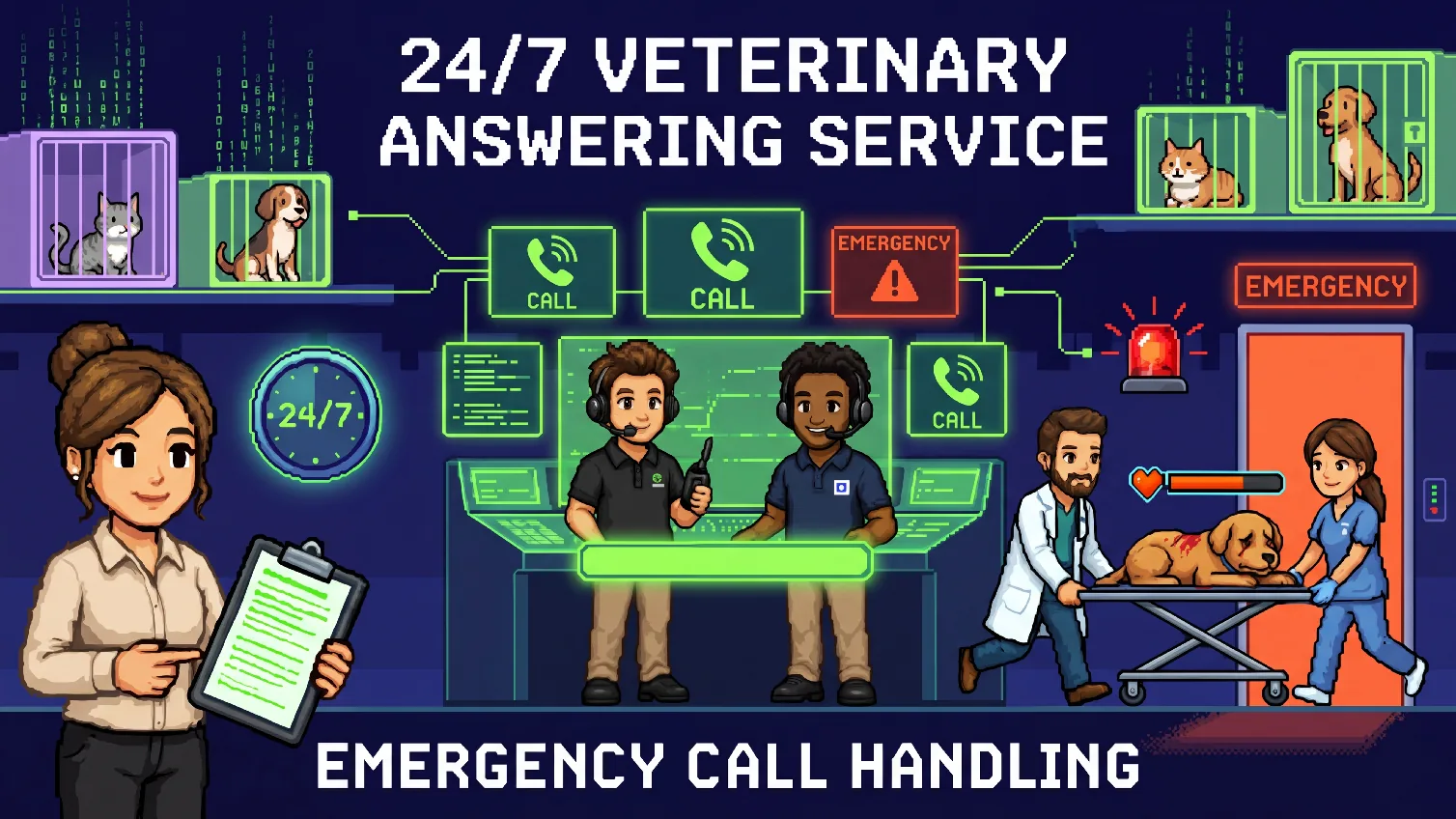
A veterinary answering service answers the phone for a veterinary clinic when the team cannot, books the appointment, and texts the pet owner back, so a missed call becomes booked work rather than a voicemail. The picks here run from an AI that answers and books on its own to live human teams, and they differ most in whether the call ends in a booked appointment or a message the office still has to action.
Veterinary Answering Service Compared
| Service | Best For | How It Handles the Call | Cost to Start (2026) |
|---|---|---|---|
| ServiceAgent | Answers, books, texts | AI, native record | Free plus usage |
| Smith.ai | AI plus human | AI, human transfer | From $300/mo |
| Ruby | Live receptionists | Live team | Per minute |
| Abby Connect | Dedicated live team | Live team | From $165/mo |
| AnswerForce | Budget live, bilingual | Live, script | Quote based |
| PATLive | No contract live | Live, no contract | Per minute |
Prices and plans change. Check each provider's current pricing page before buying.
What to Look For in a Veterinary Answering Service
A veterinary clinic loses work when a call goes to voicemail, since a pet owner usually calls the next clinic rather than wait for a callback. What matters most is answering the emergency 24/7 and whether the call ends in a booked job, and these are the factors that lead the list; the scorecard rates every service on the full set of ServiceAgent Grid capabilities below.
- Nights and weekends covered. Whether calls are answered 24/7, including nights, weekends, and holidays.
- A real person when it matters. Whether a live human can take the call, either as the whole service or as backup when the caller needs a person.
- Booked, not just messaged. Whether the appointment is booked during the call, or only left as a message for the office to schedule later.
- Texts the customer, not just a call. Whether the service follows up with the customer by SMS, so a caller who cannot talk is still reached by text.
- Cost to start. A free or low entry plan versus a per minute or per call meter that climbs with volume.
The Evaluation Criteria
The factors above are what matters most to a buyer for this search. The scorecard rates every service on the full set of criteria below, drawn from the ServiceAgent Living Grid, present, partial, or absent, so the shortlist is judged on the same Grid capabilities every time.
- 24/7 after hours coverage. Nights and weekends covered, scored present, partial, or absent from the service's 24/7 coverage.
- Live human on the call. A real person when it matters, scored present, partial, or absent from the Grid's live human coverage.
- Books the appointment. Booked, not just messaged, scored present, partial, or absent from the Grid's Appointment Booking capability.
- Two way texting (SMS follow up). Texts the customer, not just a call, scored present, partial, or absent from the Grid's SMS Follow-up capability.
- Free or low to start. Cost to start, scored present, partial, or absent from each vendor's live pricing page.
- Owns the record (native CRM). One record, not a note passed on, scored present, partial, or absent from the Grid's Native CRM capability.
- Answers with AI. AI or a live person, scored present, partial, or absent from the Grid's AI Voice capability.
- Takes a payment. Money on the call, scored present, partial, or absent from the Grid's Payments capability.
Scorecard: How Each Service Handles the 8 Criteria
Present, partial, or absent, on the same criteria the section above says to look for. Read down a column to see where each service is strong.
| Criterion | ServiceAgent | Smith.ai | Ruby | Abby Connect | AnswerForce | PATLive |
|---|---|---|---|---|---|---|
| 24/7 after hours coverage | Yes | Yes | Yes | Yes | Yes | Yes |
| Live human on the call | Escalates | Yes | Yes | Yes | Partial | Yes |
| Books the appointment | Yes | Partial | Yes | Partial | Partial | Partial |
| Two way texting (SMS follow up) | Yes | Partial | No | No | Partial | No |
| Free or low to start | Yes | No | No | Partial | No | Partial |
| Owns the record (native CRM) | Yes | No | Partial | No | Partial | No |
| Answers with AI | Yes | Partial | No | Partial | No | No |
| Takes a payment | Yes | Yes | No | No | No | Partial |
The 6 Best Veterinary answering service, Reviewed
1. ServiceAgent
ServiceAgent is an AI front office rather than a plain answering service. An AI voice agent answers every call 24/7, qualifies the caller, books the appointment into a native CRM during the call, can take a deposit, and texts a confirmation. Complex calls escalate to the business's own staff. It starts free and bills by usage, and the plans sit on its pricing page.
Best for: A business that wants the call answered, booked, and texted back automatically, with the record kept in one place.
Key Features
- An AI voice agent answers every call 24/7, so nights and weekends are covered without a person on the line.
- Books the appointment into a native CRM and texts the customer a confirmation and a reminder.
- Takes a card or a deposit on the call, and escalates a complex call to the business's own staff.
- Free to start, with usage based credits rather than a per seat fee or a per call meter.
Pros and cons
Pros
- Answers, books, texts, and keeps the record from one AI, so the office is not stitching separate tools together.
- Two way texting and confirmations are built in, not a per message fee.
- Free plan to start, with no per seat fee, no setup cost, and no per call meter.
- Cost tracks usage through credits, so a slow month costs almost nothing.
Cons
- Built to run the front office, so a business that only wants a message taker gets more than it needs.
- Credits rise in heavy months, so the bill moves with volume.
- Complex calls escalate to the business's own staff rather than a live receptionist tier.
How ServiceAgent handles the criteria
Yes
24/7 after hours coverage.
An AI answers 24/7 with no extra night rate.
Escalates
Live human on the call.
Escalates a complex call to the business's own staff rather than a live receptionist tier.
Yes
Books the appointment.
Books the appointment into a calendar and CRM on the call.
Yes
Two way texting (SMS follow up).
Native two way texting and SMS follow up are built in.
Yes
Free or low to start.
Free to start, usage based after.
Yes
Owns the record (native CRM).
A native CRM holds the customer and the booking.
Yes
Answers with AI.
An AI voice agent answers every call.
Yes
Takes a payment.
Takes a card or a deposit on the call.
Cost: Free to start; paid plans run $0 to $279/mo with a monthly credit allowance for AI and telecom usage, plus per transaction payment fees.
2. Smith.ai
Smith.ai is a hybrid receptionist service. An AI receptionist answers first, and North America based live agents take over when a call needs a person. It is one of the most established and widely reviewed services here. Billing is per call, so the cost rises in busy months, which a Smith.ai and ServiceAgent comparison lays out.
Best for: A business that wants AI answering with a human available on the hard calls.
Key Features
- An AI receptionist answers first and hands off to a North America based live agent when a caller needs more.
- Answers 24/7 and after hours at no higher rate for a night call.
- Books appointments and screens spam, and captures the caller details on the call.
- SMS and text notifications after a call, offered as a paid add on.
Pros and cons
Pros
- A real person answers the calls the AI cannot, so a high value caller reaches a live agent instead of voicemail.
- The same rate applies day or night, so covering nights and weekends costs no extra on top of the plan.
- Books appointments and filters spam callers before they reach the team.
- A mature, widely used service trusted by legal and healthcare offices.
Cons
- Priced per call, so a busy month runs past the included calls and the $11.50 a call overage raises the bill.
- Booking, texting, and extra CRM links are paid add ons, so the plan price is not the final bill.
- No native CRM, payments, or dispatch, so the job still comes back to the team.
How Smith.ai handles the criteria
Yes
24/7 after hours coverage.
Answers 24/7 at the same rate day or night.
Yes
Live human on the call.
A North America based live agent answers when the AI cannot.
Partial
Books the appointment.
Booking is available, offered as an add on.
Partial
Two way texting (SMS follow up).
SMS follow up is offered as a paid add on.
No
Free or low to start.
Starts at $300 a month for 30 calls, then $11.50 a call.
No
Owns the record (native CRM).
No native CRM; a lead is passed to a tool the office runs.
Partial
Answers with AI.
An AI answers first, then a live agent takes over.
Yes
Takes a payment.
Can capture a payment on the call.
Cost: From $300/mo for 30 calls, then $11.50 a call overage; higher plans scale toward $2,100/mo.
3. Ruby
Ruby is a live human receptionist service with US based agents and a long standing reputation for caller experience. Receptionists answer 24/7, book appointments, and take messages, and calls and texts go out from the business number through Ruby's app. Billing is per minute, with no published flat rate. See how Ruby compares with ServiceAgent.
Best for: A business where a warm human voice is part of the first impression.
Key Features
- US based live receptionists answer 24/7, so a caller reaches a real person day or night.
- Books appointments and takes messages, and transfers a call to the right person on the team.
- Calls and texts go out from the business number through Ruby's own app, not a personal cell.
- Screens spam and solicitors before a receptionist passes a call through.
Pros and cons
Pros
- A real US based person answers every call, which suits callers who expect a human.
- Calls and texts go out from the business number, so a customer always sees one company line rather than a personal cell.
- Message taking and flexible call routing are included, and the app keeps a record of who called.
Cons
- Billed per minute with no published flat rate, so a long call runs up the bill and a busy month is hard to predict.
- One of the more expensive options here, with volume often landing between $600 and $2,000 a month.
- No AI voice, no native CRM, and no native two way texting to the caller, so it answers and books but does not finish the job.
How Ruby handles the criteria
Yes
24/7 after hours coverage.
US receptionists answer 24/7.
Yes
Live human on the call.
US based receptionists answer every call.
Yes
Books the appointment.
Receptionists book the appointment during the call.
No
Two way texting (SMS follow up).
Texts go out from the business number but there is no native SMS follow up to the caller.
No
Free or low to start.
Per minute with no published flat rate, one of the pricier options.
Partial
Owns the record (native CRM).
Logs calls in its own app rather than a full CRM.
No
Answers with AI.
Every call is answered by a live receptionist, no AI.
No
Takes a payment.
Does not take payment; it books and messages.
Cost: Billed per minute of receptionist time, with no published flat rate; volume typically lands between about $600 and $2,000 a month.
4. Abby Connect
Abby Connect is a live human service that assigns a dedicated team of five to ten receptionists to each account, so the same people handle the calls. An AI plan is available under the human tier. It has the highest verified review rating of the human services here. Billing is a subscription with per minute overage. See Abby Connect against ServiceAgent.
Best for: A repeat client practice where being recognised on the phone matters.
Key Features
- A dedicated team of five to ten receptionists per account, so the same people answer rather than a different voice each time.
- Answers 24/7 and after hours, books appointments, and shares call details by email, text, or portal.
- An AI plan sits under the human tier, and choosing it doubles the included minutes.
- HIPAA handling is available as a paid add on for regulated offices.
Pros and cons
Pros
- A named, dedicated team learns the business, so repeat callers reach people who know them instead of a rotating pool.
- The best verified review pattern of the human services here, at 4.7 out of 5.
- Books appointments and routes calls, and shares the details by email, text, or portal so nothing is lost after the call.
- An AI plan is available for a business that wants to trade some of the human cost for lower pricing.
Cons
- Priced from $165 a month for 50 minutes, and reviewers note the cost climbs once the add ons are counted.
- Per minute overage above the included minutes, so a spike in calls spills over the plan.
- No native CRM, payments, dispatch, or native two way texting, so the job still comes back to the team.
How Abby Connect handles the criteria
Yes
24/7 after hours coverage.
A dedicated team answers 24/7 and after hours.
Yes
Live human on the call.
A dedicated team of receptionists answers every call.
Partial
Books the appointment.
Receptionists book, though scheduling is not deeply native.
No
Two way texting (SMS follow up).
No native SMS follow up; details are shared by email, text, or portal.
Partial
Free or low to start.
From $165 a month for 50 minutes.
No
Owns the record (native CRM).
No native CRM; details are shared by email or portal.
Partial
Answers with AI.
A live team answers, with an AI plan available.
No
Takes a payment.
Does not take payment.
Cost: From $165/mo for 50 minutes, with per minute overage above the plan; the AI plan doubles the included minutes, and HIPAA is a paid add on.
5. AnswerForce
AnswerForce is a 24/7 live human answering service for trades and small offices. Live receptionists answer, filter, and take messages, and the business writes the call script. It can book into a calendar, pass leads into common tools, and answer in English and Spanish. Billing is per minute on plans set by call volume.
Best for: A trade or small office that wants 24/7 live coverage on a budget.
Key Features
- US based live receptionists answer 24/7, including nights, weekends, and holidays.
- The call script is shaped by the business, so the after hours filter can wave through a real emergency and send the rest to a message.
- Books appointments into a calendar and passes lead details into common tools.
- Bilingual answering is available for English and Spanish callers.
Pros and cons
Pros
- Round the clock live human coverage at a lower entry than the premium human services.
- The business shapes the script, so the after hours filter routes emergencies through and holds the rest.
- Books appointments and passes leads into common tools, and answers in English or Spanish.
Cons
- Agents work from the script rather than product training, so a thin script leads to mistakes, as one reviewer warns.
- Billed by the minute on volume based plans, so a busy month climbs and the entry price is quote based.
- No AI voice and no native CRM, payments, or dispatch, so it answers and books but hands the job back.
How AnswerForce handles the criteria
Yes
24/7 after hours coverage.
Live receptionists answer 24/7 including holidays.
Partial
Live human on the call.
Live receptionists answer, working from the business's script.
Partial
Books the appointment.
Books into a calendar the business connects.
Partial
Two way texting (SMS follow up).
Some SMS follow up is available, plan dependent.
No
Free or low to start.
Quote based and billed by the minute.
Partial
Owns the record (native CRM).
Passes lead details into common tools rather than owning a CRM.
No
Answers with AI.
Every call is a live receptionist.
No
Takes a payment.
Does not take payment.
Cost: Billed by the minute on plans set by call volume; the entry price is quote based, so check the current plan on AnswerForce's own page.
6. PATLive
PATLive is a live human answering service with US based agents and no long contract. It answers 24/7, takes messages, screens calls, books simple appointments, and can collect basic payment details on the call. Billing is a subscription by the minute. It has the lowest verified review rating here.
Best for: A small business that wants flexible, no contract live coverage to start.
Key Features
- US based live receptionists answer 24/7, with no long contract to sign.
- Takes messages, screens calls, and books simple appointments.
- Can collect basic payment or order details on the call.
- Month to month billing by the minute, so a plan scales up only when call volume climbs.
Pros and cons
Pros
- Round the clock US based live answering with no long contract, so it is easy to start and stop.
- Month to month billing by the minute, so a small shop can start light and scale the plan only as calls climb.
- Can collect basic payment or order details on the call, which most human services here do not.
Cons
- The lowest verified rating here at 2.5 out of 5, with reviewers flagging long calls and inconsistent handling.
- Billed by the minute, so a chatty caller or a long call runs up the bill.
- No AI voice and no native CRM or dispatch, so it takes a message and books but does not finish the job.
How PATLive handles the criteria
Yes
24/7 after hours coverage.
US agents answer 24/7 with no contract.
Yes
Live human on the call.
US based live agents answer every call.
Partial
Books the appointment.
Books simple appointments during the call.
No
Two way texting (SMS follow up).
No native SMS follow up to the caller.
Partial
Free or low to start.
A month to month subscription billed by the minute.
No
Owns the record (native CRM).
No native CRM; it takes a message.
No
Answers with AI.
Every call is a live agent.
Partial
Takes a payment.
Can collect basic payment details on the call.
Cost: A subscription billed by the minute, with plans that scale by call volume and no long contract; check the current plan on PATLive's own page.
How the Scores, Reviews, and Prices Were Sourced
The lineup and the operator ratings come from the ServiceAgent Living Grid. The criteria are the points the section above says to look for, and each service is scored on those same criteria, not a generic list. This keeps the article consistent from the criteria to the scorecard to each tool.
- Criteria drive everything. What to look for, the scorecard, and each tool's breakdown use one set of criteria.
- Scores are honest per vendor. A service scores high only where it earns it, and ServiceAgent carries the gap it fails.
- Every quote is tied to its source. Each review is quoted verbatim with its rating from the Grid, and ServiceAgent carries no invented rating.
- Every price was checked live. Each starting price was confirmed on the vendor's own page in September 2026, and per minute services are described by model.
How to Choose the Right Veterinary answering service
The best veterinary answering service for a veterinary clinic depends on whether the call needs a human and how it gets booked. Three quick questions make the pick clear.
- Is the appointment booked when the call ends? ServiceAgent books and texts a confirmation, while a live service books but often hands the record back.
- Does the caller need a human? Ruby and Abby Connect answer with a live team, and Smith.ai adds a human behind the AI.
- What is the budget? ServiceAgent starts free, Abby Connect from $165 a month, and per minute live services climb with call volume.
Final Recommendation
For a veterinary clinic that wants the appointment booked and confirmed, ServiceAgent answers, books, and texts the pet owner back on its own. Smith.ai adds a human on the hard calls, Ruby and Abby Connect are premium live voices, and AnswerForce and PATLive keep live coverage cheap.
Compare any two tools side by side on the ServiceAgent comparisons pages before deciding.
Sources
- ServiceAgent Living Grid, capability and operator satisfaction scoring.
- ServiceAgent comparisons, the per vendor G2 reviews and ratings.
- Google US Search and AI Overview for the keyword, for the definition, use case breakdown, and People Also Ask.
- Each provider's own live pricing page, checked September 2026.
First-party data
Where these tools sit on our HVAC Living Grid
ServiceAgent publishes this market map and scores itself by the same rubric as every other vendor, from public reviews, vendor sites and changelogs. Scores are 0–100 as of Jul 2026.
- Operational Satisfaction
- How satisfied operators sound in public reviews.
- Operations Breadth × Trade-Nativeness
- How much of the front office a tool runs, and how built for the trade it is.
| Tool | Quadrant | Satisfaction | Breadth | Head to head |
|---|---|---|---|---|
| Abby Connect | High Performers | 78 | 14 | Compare |
| Smith.ai | High Performers | 68 | 28 | Compare |
| AnswerForce | High Performers | 62 | 28 | Compare |
| PATLive | Niche | 33 | 22 | Compare |
| ServiceAgentThat’s us | Leaders | 82 | 81 | All comparisons |
Source: ServiceAgent Living Grid, HVAC (Jul 2026). How we score · Market Pulse
FAQs
The questions home service operators ask most often.
What is a veterinary answering service?
A veterinary answering service answers the phone for a veterinary clinic when the team cannot, using either an AI voice agent or live receptionists. It books the appointment, takes a message, and texts the pet owner back, and it runs 24/7 so a call after hours is covered.
What is the best veterinary answering service?
ServiceAgent answers, books, and texts a confirmation 24/7. Smith.ai adds a human on the hard calls, Ruby and Abby Connect answer with a live team, and AnswerForce and PATLive keep live coverage cheap.
Can it book appointments?
Yes. ServiceAgent books the appointment into a native CRM and texts a confirmation, and the live services book with a receptionist and pass the details to the office. Confirm whether the booking lands in your calendar or comes back as a message.
Does it work after hours?
Yes. It answers 24/7, so nights, weekends, and the hours the office is closed are covered and calls stop going to voicemail. An AI tool does not charge extra for an after hours call, while a per minute live service may.
How much does a veterinary answering service cost?
It ranges from free to a per minute plan. ServiceAgent starts free and bills by usage, Abby Connect from $165 a month, and Smith.ai from $300 a month. Per minute live services like Ruby climb with call volume.
Who worked on this

Shaambhav Shankar
Growth & Product Marketing, ServiceAgent
Leads growth and product marketing for ServiceAgent at SaaS Labs, where he has worked in product marketing since 2020. Writes the blog's coverage of AI call answering, CRM and home-services operations.
Related reading
Best Answering Machine for Small Business (2026)
A modern answering machine for a small business is not a tape in a box, it is a service that answers the call, books the appointment.
Best IVR System for Small Business (2026)
IVR system for small business answers inbound calls and routes them for a business.
Best IVR System (2026)
IVR system answers inbound calls and routes them for a business, and the tools here split into two types: classic IVR phone systems that route a caller.