Table of contents
- What Does HVAC Certified Mean?
- How Long Does It Take to Get HVAC Certified?
- HVAC Certification Paths and Timelines
- EPA 608 Certification Timeline
- HVAC Certification by Experience Level
- How Long Before You Can Start Working in HVAC?
- What Affects How Long HVAC Certification Takes?
- HVAC Certification vs. HVAC License
- Fastest Way to Get HVAC Certified
- Career Timeline: From Student to Experienced HVAC Tech
- Scale Operations While You Build Your Bench
- FAQs
Running a service business is not getting any easier, especially when you are looking for talent. If you are an owner trying to scale a $2 million+ operation, you know the bottleneck is not usually finding customers, it is finding the technicians to service them. You need trucks on the road, but you cannot put a green recruit in a van without the right credentials.
The labor shortage is real, and the timeline to get a new hire from interested to revenue-generating is a critical metric for your bottom line. If you are a job seeker or career changer, understanding how long it takes to get HVAC certified also tells you how fast you can earn and grow your income.
This guide breaks down exactly how long it takes to get HVAC certified in 2026, the difference between a certification and a license, and how to keep operations smooth while you build bench strength.
What Does HVAC Certified Mean?
In HVAC, “certified” is a loose term. For a homeowner, it means the person knows what they are doing. For a business owner, it means specific legal and technical validations.
Being HVAC certified generally refers to holding professional credentials that verify competence in heating, ventilation, air conditioning, and refrigeration. It is not the same thing as a state HVAC license.
There are three common layers:
- Federal requirement EPA 608 certification: If a technician handles refrigerant, this is non-negotiable.
- Competency validations Voluntary certifications like NATE or HVAC Excellence: These help prove real-world competence and often justify higher pay.
- State licensure A license is a government-issued permit (usually at the contractor or master level) to legally operate a business and pull permits. This is often confused with “certification.”
If a candidate says they are “certified,” the two questions to ask are: Certified by whom? And does that allow them to legally do the work you need?
How Long Does It Take to Get HVAC Certified?
The timeline depends on the level of responsibility you want the technician to handle.
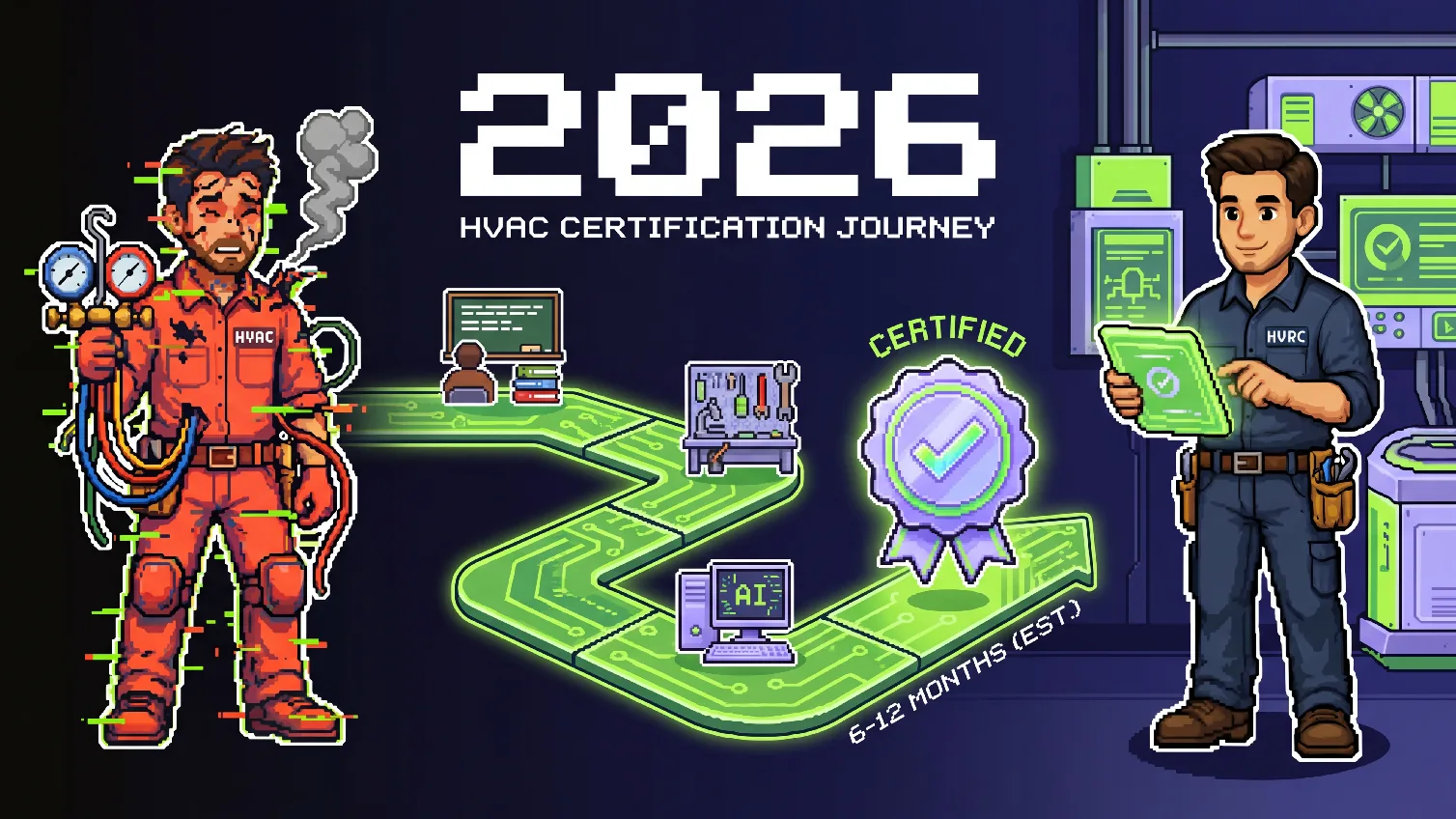
It typically takes 1–2 weeks to earn basic EPA 608 HVAC certification, 6–12 months to complete a trade school certificate, 2 years for an associate degree, and 3–5 years to complete a full HVAC apprenticeship and reach journeyman or advanced levels. The fastest path to legal refrigerant handling is the EPA 608 card.
In 2026, the timeline ranges from about one week for legal compliance to five years for advanced mastery.
Quick breakdown:
- EPA 608 (legal minimum): 1–2 weeks
- Certificate program (trade school): 6–12 months
- Associate degree: 2 years
- Apprenticeship (union or non-union): 3–5 years
For growth-focused owners, a common hiring sweet spot is graduates around the 6–12 month mark: they know fundamentals, and you can train them into your process fast.
HVAC Certification Paths and Timelines
Time is money. If you are mapping hiring and training, you need to know how long each pipeline takes.
Comparison of HVAC Certification Paths
| Path type | Duration | Best for | Pros | Cons |
|---|---|---|---|---|
| Fast-track / bootcamps | 6–14 weeks | Career changers, immediate hires | Fast entry, practical basics | Less theory, requires heavier on-the-job training |
| Certificate program | 6–12 months | Entry-level techs | Strong mix of theory and hands-on lab work | Tuition costs, student may be partly out of workforce |
| Associate degree | 2 years | Future managers, designers | Deep theory, often includes business basics | Slower route to field, may be overkill for basic installers |
| Apprenticeship | 3–5 years | Long-term career builders | Earn while learning, structured mentorship | Long commitment, requires employer or union sponsorship |
Many schools and employers are leaning toward accelerated certificate programs because equipment gets more plug-and-play while diagnostics and controls get more complex.
EPA 608 Certification Timeline
EPA 608 is the barrier to entry for most HVAC jobs involving refrigerant.
Realistic Timeline: 1 to 2 Weeks
A motivated candidate can study quickly, but a realistic flow looks like this:
- Study time: About 1 week of focused prep
- Exam duration: Roughly 2 hours (Core plus Type I, II, III)
- Results: Immediate to about 1 week depending on testing method
Types of EPA 608 Certification
- Type I: Small appliances (domestic refrigerators, window units)
- Type II: High-pressure appliances (most residential and light commercial HVAC)
- Type III: Low-pressure appliances (chillers)
- Universal: Covers all types plus the core exam
Pro tip for owners: Do not assign refrigerant-handling tasks to a tech without EPA 608. If you hire a green apprentice, make EPA 608 their first milestone within 30 days.
HVAC Certification by Experience Level
The highest-value credentials usually come after a tech is already working.
Entry-Level (0–1 Years)
- Focus: Safety and legality
- Common certifications: EPA 608 Universal, OSHA 10
- Goal: Safe on job sites and legally able to assist
Intermediate (2–4 Years)
- Focus: Competence and efficiency
- Common certifications: NATE core and specialty exams, manufacturer training (Carrier, Trane, Lennox)
- Goal: Can run most residential and light commercial calls with fewer callbacks
Advanced (5+ Years)
- Focus: Mastery and specialization
- Common certifications: Higher-level NATE, HVAC Excellence specialist credentials, state contractor or master license where required
- Goal: Handle complex troubleshooting, lead teams, train junior techs
For owners, mapping your team to this ladder helps forecast when someone is ready to move from helper to lead tech.
How Long Before You Can Start Working in HVAC?
There is a difference between certified and billable.
With a fast-track program, many candidates can ride along as a helper in about 8–14 weeks once they have EPA 608 and basic safety training.
With an associate degree path, many candidates are in school for two years, although some work part-time as helpers while studying.
Typical HVAC Work Readiness Timeline
| Path type | Earliest paid work (helper) | Typical solo billable work |
|---|---|---|
| Fast-track bootcamp | 8–14 weeks | 6–12 months |
| 6–12 month certificate | 3–6 months | 6–18 months |
| 2-year associate degree | 6–12 months (part-time) | 2–3 years |
| Apprenticeship | Immediately (under mentor) | 3–5 years |
Ride-along reality: Even after school and EPA 608, expect 3–6 months of supervised calls before a new hire consistently generates standalone revenue.
What Affects How Long HVAC Certification Takes?
Program structure: Full-time moves faster than night school Testing ability: Some great techs are not great test-takers, retakes add time State requirements: Some states require thousands of hours before certain licenses Motivation and employer support: Clear raises, reimbursements, and career ladders speed progression
HVAC Certification vs. HVAC License
Do not confuse these. This is where shops get burned.
HVAC Certification vs. HVAC License: Key Differences
| Aspect | Certification | License |
|---|---|---|
| What it is | Proof of knowledge or skill | Legal permission to operate and pull permits |
| Who issues it | Non-profits or federal agencies | State or municipal licensing boards |
| Common examples | EPA 608, NATE, HVAC Excellence | State HVAC contractor or master license |
| Required for | Refrigerant handling, credibility | Permits, contracts, advertising work as a contractor |
| Business impact | Pay differentials, marketing leverage | Legal compliance and ability to run the business |
Usually, the business owner or a master-level person holds the license, while employees hold certifications.
Fastest Way to Get HVAC Certified
If you need people in the field quickly, the fastest path in 2026 is often a hybrid model.
Typical fast-track structure:
- Online theory (self-paced): 2–4 weeks
- EPA 608 prep and testing: by week 4
- Intensive lab boot camp: 2–3 weeks in person
- Total time: About 6–8 weeks from zero to a safe apprentice with EPA 608 who can assist on installs and basic maintenance.
Owners still need structured onboarding and QA so speed does not create safety or callback problems.
Career Timeline: From Student to Experienced HVAC Tech
- Year 0–1: EPA 608, doing maintenance, learning tools and systems
- Year 2–4: Running most service calls, building speed and confidence, fewer callbacks
- Year 5–7: Specializations, handling complex diagnostics, mentoring juniors
- Year 8+: Licensed contractor or master where required, leadership roles, system design, operations
Scale Operations While You Build Your Bench
While you are waiting 6 to 12 months for new technicians to become certified and productive, your business does not pause. Calls keep coming. Leads keep coming. And many shops lose revenue simply because they cannot handle every inbound request properly.
You cannot clone your best technician instantly, but you can create front-office coverage that scales.
How ServiceAgent.ai Helps Bridge the Certification Gap?
ServiceAgent.ai is built for trade and home services businesses that want to grow without dropping the ball on intake.
How it helps HVAC businesses:
- Never miss an HVAC lead: Answers calls day or night so “no cool” and tune-up requests do not hit voicemail
- Intelligent booking and dispatch handoff: Books directly into calendars and field systems, tags jobs by type and priority
- After-hours and peak-season overflow: Handles high call volume without busy signals
- Better intake data: Captures symptoms, system details, urgency, and service area so techs arrive better prepared
- Analytics: Tracks call volume, bookings, and missed-call savings so you can see revenue protected while techs ramp
If your growth is constrained by how fast you can get people certified and truck-ready, ServiceAgent.ai can keep your lead capture and booking engine running in the meantime.
Talk to the ServiceAgent.ai team and see how AI can cover your phones 24/7 while you build your bench of certified techs.
FAQs
The questions home service operators ask most often.
1. How long does EPA 608 certification last?
EPA 608 certification does not expire under current rules. If a tech loses their card, they can request a replacement from the testing organization.
2. Can you get HVAC certified online?
You can complete much of the theory online and sometimes take EPA 608 through online proctoring. But hands-on lab and field experience still matters a lot for employers.
3. What certification do you need to work with HVAC refrigerant?
You need EPA Section 608 certification to legally handle regulated refrigerants in the United States. Universal is usually the most flexible.
4. What is the hardest HVAC certification to get?
Higher-level certifications and specialized commercial credentials can be the toughest because they require broad multi-system knowledge. State contractor license exams can also be challenging because they may include codes and business law.
5. Do you need a degree to become an HVAC technician?
No. Many technicians enter through trade school certificates or apprenticeships. Degrees can help for management or design paths, but field employers prioritize certification and skills.
6. How much does it cost to become HVAC certified?
Costs vary by path. EPA 608 is usually inexpensive compared to full programs. Certificate programs range widely based on location, duration, and what tools are included.
7. Is HVAC a good career in 2026?
Yes. Demand remains strong, especially for technicians who keep learning and specialize. Pairing skilled field work with strong operations is the fastest path to higher income and growth.
Who worked on this

Shaambhav Shankar
Growth & Product Marketing, ServiceAgent
Leads growth and product marketing for ServiceAgent at SaaS Labs, where he has worked in product marketing since 2020. Writes the blog's coverage of AI call answering, CRM and home-services operations.

Marcus Chen
HVAC Industry Expert · Reviewer
NATE-certified Master HVAC Technician with 14 years in residential and light-commercial HVAC. Former Senior Service Tech at Trane Austin, now reviews HVAC content for ServiceAgent.
Related reading
HVAC Service Contract: What it is, What it Includes, and How HVAC Companies Use It to Grow in 2026
Learn what an HVAC service contract is, what it includes, typical pricing, and how HVAC companies use service agreements and AI to grow in 2026.
HVAC Marketing Strategies: How HVAC Companies Get More Leads in 2026
Discover proven HVAC marketing strategies for 2026 to get more leads, improve ROI, and turn missed calls into booked jobs with AI automation.
HVAC License Requirements: State-by-State Rules & Certification Guide (2026)
HVAC license requirements by state in 2026: experience hours, exams, EPA 608 certification, and how to become a licensed HVAC technician or contractor.