Table of contents
- Why an Unanswered Patient Call Costs More Than a Missed Appointment
- The Three Delivery Models, and How Each One Fails
- The Best Healthcare Answering Services in 2026
- 1. TeleMed Inc
- 2. ServiceAgent
- 3. CallMyDoc
- 4. notifyMD
- 5. MAP Communications
- 6. Smith.ai
- Other Services Worth a Look
- What a Healthcare Answering Service Actually Does
- Seven Things to Check Before You Sign
- What Each Model Costs, and Where It Breaks
- How to Work Out What a Month Will Really Cost
- Which Model Fits Your Practice
- Which Model Fits Your Call Volume
- The Call Type Where the Wrong Choice Is Not Acceptable
- Must-Have Features, Whichever Model You Pick
- Answering Service or Hiring In-House
- How to Choose
- The Verdict
- HVAC Living Grid
- FAQs
A healthcare answering service is a 24/7/365 call-handling service that answers patient calls, triages urgent medical issues from routine ones, books and reschedules appointments, and escalates emergencies to the on-call provider, all under HIPAA safeguards and a signed Business Associate Agreement. That definition covers three genuinely different products, and choosing between them decides your cost structure and your failure mode.
Most comparisons skip straight to a ranked list. That is the wrong order for this decision, because a traditional live agent service and an AI voice platform are not competing on price, they are competing on what happens when a frightened patient calls at 11pm. This guide starts with the three models, prices each one honestly, and gives you the seven things to check before signing.
We build AI voice answering for service businesses, so we have a stake in one of those three models and we will say so where it matters. We also say plainly where an AI service is the wrong choice for a clinical call, because in healthcare the wrong answer is not an inconvenience.
Why an Unanswered Patient Call Costs More Than a Missed Appointment
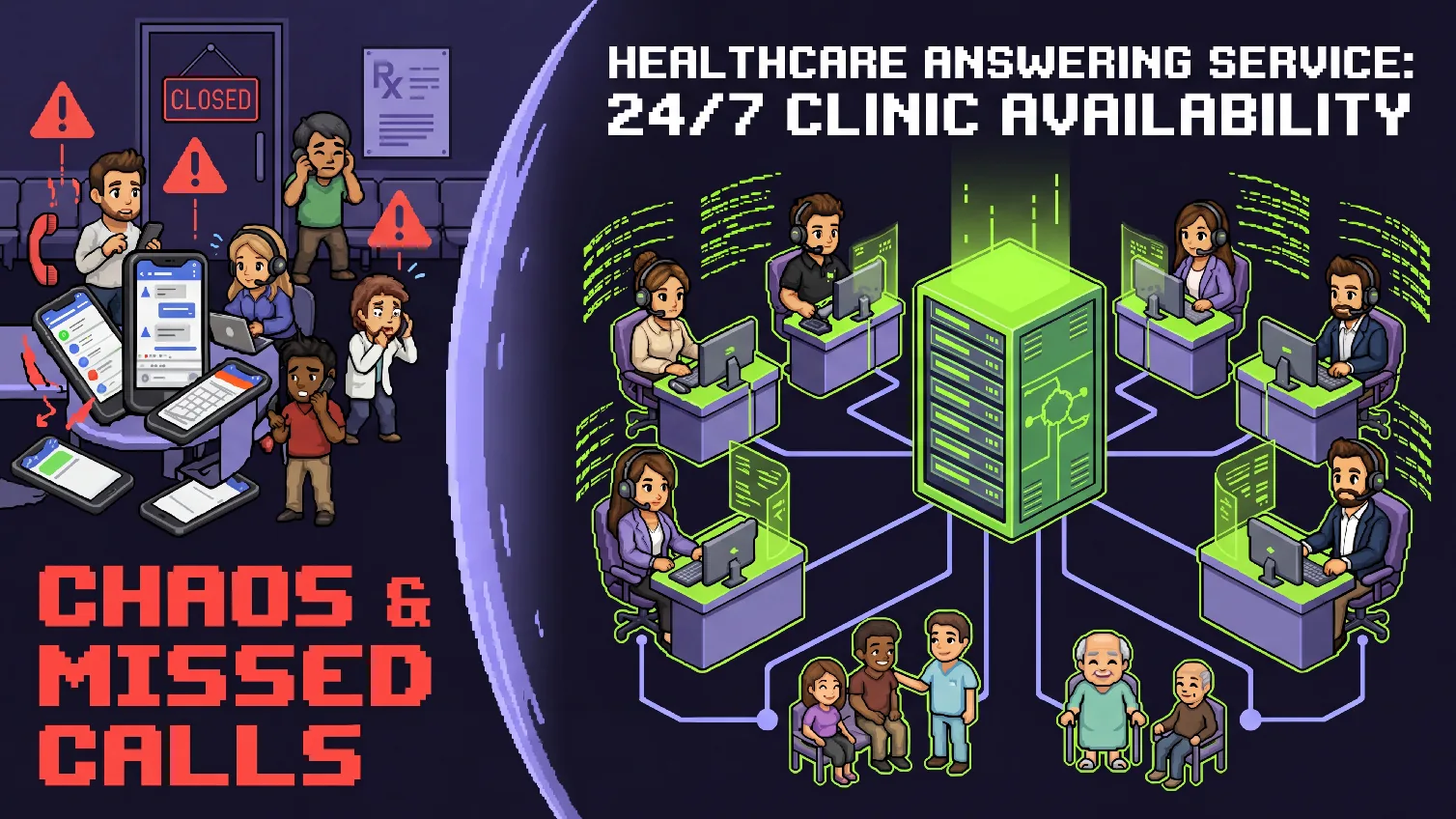
The front desk phone is the busiest interface a practice has, and it fails in a specific direction. Calls pile up at opening, at lunch and in the hour after closing, which is exactly when the staff who could answer them are triaging a waiting room.
When those calls go to voicemail, the practice has not deferred a task. It has handed a triage decision to the patient. A parent with a feverish child at 11pm, a post-operative patient unsure whether swelling is normal, someone weighing whether chest tightness is indigestion: each of them decides, without clinical input, whether to wait until morning or go to an emergency room. Both wrong answers are expensive, and one of them is dangerous.
The operational cost is easier to see. Voicemail creates a morning message backlog, so the first hour of every day goes on calls that should have closed the night before, and staff carry that fatigue into patient-facing work. Front-desk burnout is among the most reliable predictors of turnover, and replacing that hire costs more than a year of any service here. Patients notice too: dropped calls and long hold times are among the most common complaints in practice reviews, and someone who cannot get through once usually tries a different practice rather than calling twice.
So the question is not whether to cover the phone. It is which of the three models should do it.
The Three Delivery Models, and How Each One Fails
Every healthcare answering service on the market is one of these three. The differences are not marketing positioning; they change what the service can do at 11pm and what it costs in a busy month.
| Model | Who answers | Cost structure | Fails when |
|---|---|---|---|
| Traditional live agents | Medically trained operators following your practice scripts | $1.00 to $2.00 a minute or $0.75 to $1.50 a call, monthly minimums $100 to $300 | Call volume spikes, because every minute is metered and overages compound |
| Dedicated virtual receptionists | A named small team who learn your practice and greet as you | Flat volume tiers, about $300 to $1,500+ a month | Volume outgrows the tier, or the price outgrows the value for routine calls |
| AI voice platforms | An AI voice, with routing based on request type | Flat monthly rate, generally no per-minute meter | A caller is distressed, ambiguous or clinical and needs a human immediately |
Traditional live agents
The legacy model, and still the default for clinical work. Medically trained operators follow complex practice scripts, separate routine inquiries from urgent medical needs, and page the on-call provider for STAT calls through a secure mobile application, with live bilingual English and Spanish agents standard at the better services and call logs audited. The strength is judgment: a trained operator hears hesitation and distress and escalates on signals no keyword list captures. The weakness is the meter, because the months you most need coverage are the months the invoice climbs.
Dedicated virtual receptionists
A small named team answers as your practice rather than as a call centre, learns your providers and patients, and handles warm patient intake and scheduling. For a boutique or solo clinic where the greeting is part of the brand, this is the model that sounds like an extension of the practice. It is also the most expensive per call, and priced in volume tiers rather than per minute, so the risk is buying a tier you do not fill or outgrowing one mid-quarter.
AI voice platforms
An AI answers on the first ring with no hold time, identifies the caller, categorises the request, handles routine work like scheduling, refills, result inquiries and appointment confirmations, and routes anything else onward. Pricing is generally flat monthly with no per-minute charge, which removes overage risk entirely. The trade-off is the one thing it cannot do: algorithmic routing by request type is fast and consistent, and it is not clinical judgment. A patient in genuine distress needs a person, and if the platform has no live tier there is nobody to transfer them to.
Most practices end up using more than one of these. The decision below assumes that.
The Best Healthcare Answering Services in 2026
| Provider | Model | Best for | Pricing | |
|---|---|---|---|---|
| 1 | TeleMed Inc | Traditional live agents | Practices needing genuine clinical triage after hours | Per-minute, quote based on volume |
| 2 | ServiceAgent | AI voice platform | Practices whose bottleneck is booking and after-hours pickup, not triage | Launch free, Core $39, Growth $95 yearly |
| 3 | CallMyDoc | AI voice platform | Practices on athenahealth, Veradigm or Altera wanting EHR-connected AI | Flat monthly, quote only, no per-call charge |
| 4 | notifyMD | Traditional live agents | Multi-provider practices with complex on-call rotations | Per-minute, quote based on volume |
| 5 | MAP Communications | Traditional live agents | Solo and startup practices wanting the lowest live-agent entry | From $44 a month plus per-minute |
| 6 | Smith.ai | AI plus live agent backup | Practices wanting measurable call outcomes and reporting | $292.50 for 30 calls |
Pricing for the live services is quote-based on call volume, which is why the table gives structure rather than a single figure. Every entry below states what is published and what is not.
1TeleMed Inc
TeleMed is a medical-only answering service, which is the distinction that matters most here. Its operators are not general call centre staff trained on a healthcare script; the entire business is medical call handling, and the depth shows in how on-call escalation is built. Practices choose it when after-hours calls are genuinely clinical and a wrong triage decision is unacceptable. The trade-off is that everything is metered, so a busy month is an expensive month.
Best for: practices where after-hours calls need real triage rather than message-taking, particularly specialties with post-operative or acute patients.
- Medically trained live operators, 24/7/365 including weekends and holidays
- Call triage separating routine inquiries from urgent medical needs
- On-call escalation protocols routing STAT calls to the physician on duty
- Secure smartphone application for message delivery and audited call logs
- Live bilingual English and Spanish coverage
- HIPAA-compliant handling with a Business Associate Agreement
- Medical-only operators, so triage judgment is genuinely better than a general service
- Documented HIPAA handling, which four of the eight services commonly listed in this category do not publish
- Complex on-call rotations handled reliably, which is where cheaper services break
- Decades of clinical call handling rather than a healthcare vertical bolted onto a call centre
- Per-minute billing, so cost rises exactly when volume does
- Pricing is quote-only, so it cannot be compared without a sales conversation
- Monthly minimums apply, which penalises low-volume practices
- No AI tier, so routine booking calls cost the same per minute as clinical ones
Pricing: per-minute, quoted against your call volume, with monthly minimums in this market typically $100 to $300. Ask for the overage rate in writing, because verified overages across this category reach $4.70 a minute.
Bottom line: the safest choice when the calls are clinical, and the most expensive way to answer a scheduling question.
2ServiceAgent
ServiceAgent is our own product, so read the limitations first. It is an AI voice platform that answers every call on the first ring including nights and weekends, captures the caller and the reason for the call, books the appointment into the calendar, and can take a deposit before the call ends, on a flat plan with no per-minute meter and no per-user fee.
It is built for booking and pickup, not triage. Where the actual problem is that after-hours calls reach voicemail and never become appointments, that is the whole job. Where those calls are clinical, it is the wrong tool and the entries above name the right ones.
Best for: practices whose bottleneck is appointment booking and after-hours pickup rather than clinical triage, and who want a predictable flat bill instead of a per-minute meter.
- Answers on the first ring, 24/7, with no hold time and no voicemail
- Appointment booking written directly into the calendar during the call
- Deposit collection before the caller hangs up, which reduces no-shows
- Flat monthly plan with no per-minute charge and no per-user fee
- Two-way Google Calendar and Outlook Calendar sync, plus QuickBooks and Zapier
- Launch tier at no cost, so the whole thing can be tested against real calls
- No per-minute meter, so a busy month costs the same as a quiet one
- Removes the overage risk that is the main financial complaint about live services
- Books the appointment rather than taking a message, so nothing waits for the morning backlog
- A free tier means it can be tested before any commitment
- HIPAA compliance and a signed Business Associate Agreement are not documented, and must be confirmed in writing before any patient call is routed through it. Without a signed BAA the practice, not the vendor, carries the violation.
- SOC 2 Type II certification is in progress rather than complete, which will fail a procurement review that requires it
- It is an AI voice, and callers know they are not speaking to a person
- No live human tier, so a distressed or clinically ambiguous caller cannot be transferred to a person
- Not a triage service, and should never be the only line for acute or post-operative patients
- Credits reset monthly with no rollover, so a quiet month is spend you do not recover
Pricing: Launch free, Core $39 a month billed yearly, Growth $95, Franchise $279. AI voice time costs 15 credits a minute, so Growth covers about 400 minutes, which works out near $0.24 a minute. That is roughly a fifth of a live agent's per-minute rate, and it buys a fundamentally different service.
Bottom line: the right answer for booking and pickup at a flat price, and the wrong one for clinical triage or for any practice that cannot get a BAA in writing first.
3CallMyDoc
CallMyDoc is the most thoroughly documented compliance position in this comparison, and the only AI platform here with named ambulatory EHR integrations. It is HIPAA compliant and SOC 2 certified, encrypts PHI in transit and at rest, maintains access controls and a complete audit trail, and integrates with athenahealth, Veradigm Professional EHR and Altera TouchWorks.
It identifies the patient, pulls the chart from the EHR, categorises the call into one of twelve request types, and handles routine work automatically. Pricing is flat monthly with no per-call charge, no setup fee and no long-term contract.
Best for: practices already on athenahealth, Veradigm or Altera that want AI answering with the compliance documentation a procurement review will actually accept.
- HIPAA compliant and SOC 2 certified, with PHI encrypted in transit and at rest
- Access controls and a complete audit trail for audit-ready records
- Named integrations with athenahealth, Veradigm Professional EHR and Altera TouchWorks
- Patient identification and chart retrieval during the call
- Twelve request-type categorisation covering scheduling, refills and result inquiries
- Flat-rate pricing with no per-call charges, no setup fee and no long-term contract
- The strongest published compliance stack here, which removes the BAA uncertainty that affects several competitors
- Real EHR integration rather than generic API-based routing, so data reaches the chart
- Flat-rate with no per-call charge, which removes overage risk
- No setup fee and no long-term contract, unusual in a category built on annual agreements
- Pricing is quote-only, so it cannot be compared without a sales call
- The EHR integrations are its strength and its constraint; practices on eClinicalWorks or Epic need to confirm support
- Its performance figures, including the 11-minute median physician response time and 27 million calls handled, are vendor-reported and not independently audited
- It publishes its own 'best medical answering service' comparison content, so treat its own rankings as marketing
Pricing: flat monthly, quote only, with no per-call charges, no setup fee and no long-term contract. Ask for the rate against your call volume and confirm your specific EHR is on the supported list before anything else.
Bottom line: the best-documented AI option and the obvious shortlist entry if your EHR is one of the three it names.
4notifyMD
notifyMD is built around the problem that breaks most cheaper services: on-call rotations. Multi-provider practices where the on-call physician changes nightly and escalation rules differ by provider and call type need a service whose architecture assumes that complexity. It is a traditional live model, so the economics match TeleMed's: strong judgment, metered minutes.
Best for: multi-provider practices and small groups with complex, frequently changing on-call schedules.
- Live operators with documented HIPAA-compliant call handling
- On-call rotation management with per-provider escalation rules
- STAT call routing to the physician on duty via secure messaging
- Appointment message handling and patient callback coordination
- Audited call logs and encrypted message delivery
- Bilingual coverage for Spanish-speaking patients
- On-call rotation handling is genuinely better than general answering services
- Documented HIPAA-compliant handling with a BAA available
- Escalation rules can differ by provider, which matters in group practices
- Long track record in medical call handling specifically
- Per-minute billing with monthly minimums, so low-volume practices overpay
- Quote-only pricing with no published rates
- No AI tier, so routine and clinical calls cost the same
- Overkill for a solo practice with a single on-call provider
Pricing: per-minute, quoted against call volume, with monthly minimums typical for the category at $100 to $300. Get the overage rate in writing.
Bottom line: the right answer when the on-call schedule is the complicated part, and unnecessary spend when it is not.
5MAP Communications
MAP Communications has been in medical answering for decades and publishes a dedicated HIPAA-compliant answering service offering with BAAs available for medical clients. Its distinguishing feature in this comparison is the entry price: from $44 a month plus per-minute charges, which is the lowest live-agent starting point here.
That base makes it practical for a solo or startup practice needing live coverage without a $300 minimum. The per-minute charges still apply, so the low entry is a floor rather than a forecast.
Best for: solo practitioners and new practices needing 24/7 live coverage at the lowest possible entry cost.
- 24/7 live operator coverage with agents trained on HIPAA protocols
- Business Associate Agreements available for medical clients
- Dedicated offerings for clinics, medical centres and hospitals
- Appointment scheduling and message delivery
- Bilingual support for Spanish-speaking patients
- Decades of operating history in medical answering
- From $44 a month, the lowest live-agent entry price in this comparison
- Offers BAAs, so the compliance question has a documented answer
- Separate offerings for clinics and hospitals rather than one generic script
- Long operating history, which matters for a service holding patient data
- Per-minute charges sit on top of the $44 base, and the rate is not published
- Reported at $1 to $2 a minute, but that figure does not come from MAP
- A general answering service with a medical division rather than a medical-only operation
- Triage depth is lighter than TeleMed's or notifyMD's
Pricing: from $44 a month plus per-minute charges. The per-minute rate is reported at $1 to $2 but is not published by MAP, so treat it as reported and get a written quote against your volume.
Bottom line: the cheapest way into live coverage, and the base price is the beginning of the number rather than the end of it.
6Smith.ai
Smith.ai runs an AI-first model with live agent backup, which makes it the only genuine hybrid in this comparison. Calls are routed by AI and handed to a human when the situation calls for one, and the reporting layer is the strongest here: call outcome tracking and traceable records that let a practice measure what the phone is actually producing.
It is priced per call rather than per minute, and it is not cheap: verified at $292.50 for 30 calls, about $9.75 each, so it suits practices where a call is worth substantially more than that.
Best for: practices that want measurable call outcomes and a human available, with call volumes low enough that per-call pricing works.
- AI-first routing with live agent backup for calls that need a person
- Call outcome tracking and traceable reporting
- CRM and calendar integration with intake handled by the service
- Appointment booking and patient intake questions
- Per-call rather than per-minute billing, so long calls do not compound
- Established operation with a substantial review record
- The only true AI-plus-human hybrid here, so a distressed caller does reach a person
- Reporting and call outcome tracking are the best in this comparison
- Per-call pricing is easy to forecast against a known patient volume
- No per-minute meter, so a long clinical call does not produce a surprise
- $9.75 a call is far above any per-minute service at typical call lengths
- Costs scale linearly with volume, so it does not suit a busy practice
- Not a medical-only service, so triage depth is lighter than TeleMed's or notifyMD's
- Confirm the current HIPAA and BAA position directly, because comparison tables in this category are unreliable about it
Pricing: verified at $292.50 for 30 calls, roughly $9.75 a call. Note that figures circulating in comparison content, including a free tier of 25 calls and a $150 to $800 monthly range, do not match verified pricing.
Bottom line: the best hybrid and the best reporting, at a per-call price that only works at low volume.
Other Services Worth a Look
- MedConnectUSA, a medical-only live answering service with documented HIPAA-compliant handling, worth quoting alongside TeleMed and notifyMD.
- Abby Connect, the dedicated virtual receptionist option, verified at $329 a month at the Essential tier rising to about $1,380, suited to boutique and solo clinics where the greeting is part of the brand.
- Ruby, the other established dedicated virtual receptionist option, offering warm patient intake and deeply branded call handling in the same $300 to $1,500 tier range. Like Abby Connect it is not a medical-only service, so confirm the BAA position in writing.
- AnswerForce, a general answering service with automated intake, bilingual support and bundled live chat, priced by minute bundles with a setup fee. Confirm the medical BAA position in writing, because it is not a medical-only service.
What a Healthcare Answering Service Actually Does
Now that the options are on the table, it is worth being precise about the job, because the category name is broader than the work. A healthcare answering service handles the following.
- Answers every inbound patient call 24/7/365, including after hours, weekends and holidays, so nothing reaches voicemail
- Triages calls, separating routine inquiries from urgent medical needs using your practice's own criteria
- Escalates STAT calls to the on-call provider through a secure mobile application, following per-provider rules
- Books, reschedules and cancels appointments, and confirms existing ones to reduce no-shows
- Absorbs routine administrative calls: billing questions, insurance queries, directions, prescription refill requests
- Delivers messages into a client portal or, where integration exists, into the patient chart in your EHR
- Maintains encrypted records and audit logs so call handling is audit-ready
What it will not do is practise medicine. It does not diagnose, advise on whether a symptom is dangerous, or decide treatment. Triage here means routing by urgency against rules you set, not clinical assessment, and the clinical judgment stays with your on-call provider. Any service implying otherwise is describing something you should not buy. That boundary is why the escalation path matters more than any other feature: the job is getting the right call to the right clinician quickly, not resolving it.
Seven Things to Check Before You Sign
These are in priority order, and the first one is disqualifying rather than merely important.
- Compliance and security. Ask for the signed Business Associate Agreement before the demo. Look for SOC 2 Type II, ISO 27001 and PCI DSS if payment data is involved, plus encryption in transit and at rest, access controls and audit logs. A vendor that will not put the BAA in writing is not a candidate.
- Triage and escalation. Ask how urgent is separated from routine, and how a STAT call reaches the on-call provider. Operators read distress; AI routing keys off request type. Decide which calls each should handle.
- EHR and EMR integration. Named integrations, not API-based routing. Confirm your system, whether athenahealth, eClinicalWorks, Veradigm or Altera, and ask whether data reaches the chart or stops at a client portal.
- Coverage and availability. 24/7/365 including weekends and holidays, with written after-hours escalation. Ask what happens during a volume spike, because that is when coverage claims are tested.
- Scalability and pricing model. Ask for the overage rate, the monthly minimum, and the cost at double your volume. Verified overages here reach $4.70 a minute, which is where budgets break.
- Analytics and reporting. Call outcome tracking, no-show reduction and patient satisfaction data. A service reporting only call counts cannot be evaluated.
- Staff efficiency. Establish which routine calls it absorbs: billing, insurance, directions, confirmations. That offload is the return on the spend and what reduces front-desk burnout.
Two of these seven are worth failing a vendor over. No BAA, and no clear escalation path for an urgent call.
What Each Model Costs, and Where It Breaks
| Model | Base | Metered | What breaks the budget |
|---|---|---|---|
| Traditional live agents | $100 to $300 monthly minimum | $1.00 to $2.00 a minute or $0.75 to $1.50 a call | Overages, verified as high as $4.70 a minute in this category |
| Dedicated virtual receptionists | $300 to $1,500+ a month by tier | Included to the tier cap | Outgrowing the tier mid-quarter, or underfilling it |
| AI voice platforms | Flat monthly, from free to a few hundred | Generally none, or a credit allowance | Credit allowances that reset without rollover |
| AI plus live hybrid | Per-call packages | About $9.75 a call at verified Smith.ai pricing | Volume, because per-call cost scales linearly |
Live models are cheap to start and expensive when busy. AI models are predictable and cannot exercise judgment. Hybrids buy judgment back at a per-call price. Nothing here is cheapest at every volume, and whichever you pick, insist on the overage rate: it is the figure most often left out of a quote and the one most likely to appear on a second invoice.
How to Work Out What a Month Will Really Cost
Quotes in this category are given per minute or per call, and neither tells you what you will pay. Four steps turn a rate into a number.
- Count the calls the service will actually take. Not your total call volume, only what you are routing: after-hours calls, weekend calls, and daytime overflow. Pull a month from your phone log rather than estimating, because estimates in this category are always low.
- Measure your average call length. Message-taking runs one to two minutes. Appointment booking runs three to four. Triage calls run longer. Use your own average, not the vendor's example.
- Multiply for the metered models, then check it against the minimum. Calls times minutes times the per-minute rate, or calls times the per-call rate. If the result is under the monthly minimum, you pay the minimum.
- Add the overage. Ask for the rate above your bundle and price a month at 50 per cent above normal volume, because that is the month you bought the service for.
Worked through with real numbers: a practice routing 150 calls a month at a three-minute average is 450 minutes.
| Option | Monthly cost at 450 minutes | Effective per minute |
|---|---|---|
| Live agent at $1.50 a minute | $675 | $1.50 |
| Live agent at $2.00 a minute | $900 | $2.00 |
| Live agent at a $4.70 overage rate | $2,115 | $4.70 |
| Smith.ai at $9.75 a call | $1,462.50 | $3.25 |
| ServiceAgent Growth plus two Safe Packs | $135 | $0.30 |
Same practice, same patients, same month, and a spread of nearly eleven times depending only on which model answers the phone. Two caveats on that table: the ServiceAgent line covers 400 minutes on Growth, so 450 requires two Safe Packs at $20 each, and it is booking rather than triage. The $4.70 row is not a scare figure but a verified overage rate, and it is what a busy month costs once the bundle runs out. Run your own numbers through those four steps before any demo.
Which Model Fits Your Practice
| Practice type | Dominant call type | Best fit |
|---|---|---|
| Solo or startup practice | Mixed, low volume | MAP Communications for live coverage from $44, or an AI platform for booking |
| Multi-provider group | Complex on-call escalation | notifyMD, or TeleMed where triage depth matters most |
| Specialty with acute or post-operative patients | Clinical and urgent | TeleMed. Do not put an AI-only service on this line |
| Boutique or concierge clinic | Brand-sensitive patient intake | Abby Connect, at $329 to about $1,380 |
| Practice on athenahealth, Veradigm or Altera | Routine scheduling, refills, results | CallMyDoc, for the EHR integration and the compliance documentation |
| Practice losing appointments to voicemail | Booking and after-hours pickup | An AI voice platform on a flat plan, with a live service behind it for clinical calls |
| Multi-location group | Scheduling consistency across sites | A live service with multi-location support, or CallMyDoc if the EHR is shared |
Which Model Fits Your Call Volume
| Monthly calls routed | What decides it | Best fit |
|---|---|---|
| Under 50 | Monthly minimums dominate, so per-minute is wasteful | MAP Communications from $44, or an AI platform on a free or entry tier |
| 50 to 200 | The crossover band, where model choice matters most | AI for booking, live for clinical; price both against the four steps above |
| 200 to 500 | Overage rates start to dominate the invoice | Flat-rate AI for routine calls, live service reserved for triage |
| 500 to 2,000 | Per-call pricing breaks down entirely at this volume | Flat-rate platforms, or a live contract negotiated on committed volume |
| 2,000 or more | Multi-location routing and governance | Enterprise live contract with audit logs and role-based admin |
The 50-to-200 band is where most single-site practices sit, and it is exactly where the eleven-times spread above applies. Above 500 calls a month, per-call pricing stops being a serious option regardless of who is selling it.
The Call Type Where the Wrong Choice Is Not Acceptable
Every model above handles scheduling, refills, insurance questions and directions competently. They diverge on exactly one call: the patient who does not know how serious their situation is.
That caller is not asking a question the system can categorise. They are describing symptoms in an uncertain voice and looking for someone to tell them whether to wait. A trained human operator escalates on tone and hesitation. Algorithmic routing based on keyword or request type does not, because the caller has not used the keyword. If your after-hours calls include that patient regularly, a live service or a hybrid with a human tier is not a preference, it is the requirement.
This is also where an honest limitation belongs. ServiceAgent has no live human tier, so a distressed caller cannot be transferred to a person. That is the reason its entry above says it is the wrong tool for triage, and the reason a practice with acute patients should keep a live service on the clinical line even if AI handles the booking one.
Must-Have Features, Whichever Model You Pick
- A signed Business Associate Agreement, provided before you commit rather than after
- 24/7/365 coverage including weekends and holidays, with a written after-hours escalation path
- Call triage against your own urgency criteria, and STAT routing to the on-call provider via secure messaging
- Appointment booking and confirmation, not message-taking alone, because a message still costs you the morning callback
- Encrypted records, access controls and audit logs, so call handling survives an audit
- Bilingual English and Spanish coverage at all hours, not only during business hours
Anything beyond those six is a preference. Any service missing one of them is not a candidate, whatever it costs.
Answering Service or Hiring In-House
- Cost. A full-time front-desk hire covering evenings and weekends requires more than one person once holidays and sick leave are counted. Every service on this page costs less than that, most of them by an order of magnitude.
- Coverage. 24/7/365 is straightforward to buy and difficult to staff. An in-house team covering nights and weekends is three shifts, not one hire.
- Consistency. A service follows the script every time. Staff quality varies with fatigue, and the phone is answered worst exactly when the practice is busiest.
- The catch. An employee knows your patients, notices that a caller sounds worse than last week, and can walk down the corridor to ask a clinician. No service does any of that. What you are buying is coverage and consistency, not judgment or familiarity, and for the calls where familiarity matters most, in-house still wins.
How to Choose
Choose a live or hybrid service if
- After-hours calls are clinical rather than administrative
- You treat acute, post-operative or behavioural health patients
- On-call rotations are complex and change frequently
- You need a documented BAA and audit-ready records today rather than after a procurement cycle
Choose an AI voice platform if
- The problem is appointment booking and after-hours pickup rather than triage
- Per-minute overages have already produced an invoice you did not expect
- Routine scheduling, refills and confirmations are most of the call volume
- You can get the compliance position in writing before any patient call is routed
The Verdict
Pick the model before the brand. Clinical after-hours calls: TeleMed or notifyMD, and accept the meter. Routine calls on athenahealth, Veradigm or Altera: CallMyDoc, which has the best documented compliance here. Solo and needing live coverage cheaply: MAP Communications from $44. Calls worth well over $9.75 with reporting that proves it: Smith.ai.
And if the honest problem is that patients call after hours, reach voicemail, and never become appointments, that is a booking problem rather than a triage problem, and it is the cheapest one on this page to fix.
For that specific job, ServiceAgent answers on the first ring at any hour, books the appointment into the calendar during the call, and can take a deposit before the caller hangs up, on a flat plan from free to $279 a month with no per-minute meter and no overage rate to negotiate. Two things must be true before you use it in a healthcare setting: confirm the HIPAA position and get a signed Business Associate Agreement in writing before any patient call is routed through it, because without one the practice carries the violation rather than the vendor, and keep clinical triage with a live service, because there is no human tier to transfer a distressed patient to. Used for booking, alongside a live service for clinical calls, it removes the morning message backlog without adding a per-minute bill.
First-party data
Where these tools sit on our HVAC Living Grid
ServiceAgent publishes this market map and scores itself by the same rubric as every other vendor, from public reviews, vendor sites and changelogs. Scores are 0–100 as of Jul 2026.
- Operational Satisfaction
- How satisfied operators sound in public reviews.
- Operations Breadth × Trade-Nativeness
- How much of the front office a tool runs, and how built for the trade it is.
| Tool | Quadrant | Satisfaction | Breadth | Head to head |
|---|---|---|---|---|
| Abby Connect | High Performers | 78 | 14 | Compare |
| Smith.ai | High Performers | 68 | 28 | Compare |
| AnswerForce | High Performers | 62 | 28 | Compare |
| ServiceAgentThat’s us | Leaders | 82 | 81 | All comparisons |
Source: ServiceAgent Living Grid, HVAC (Jul 2026). How we score · Market Pulse
Frequently Asked Questions
The questions home service operators ask most often.
What is a healthcare answering service?
A 24/7/365 call-handling service that answers patient calls, triages urgent medical issues from routine ones, books and reschedules appointments, and escalates emergencies to the on-call provider, under HIPAA safeguards and a signed Business Associate Agreement. It comes in three forms: traditional live agents, dedicated virtual receptionists, and AI voice platforms.
How much does a healthcare answering service cost?
Traditional live agents run about $1.00 to $2.00 a minute or $0.75 to $1.50 a call, with monthly minimums of $100 to $300. Dedicated virtual receptionists run flat tiers from about $300 to $1,500 or more a month. AI voice platforms charge flat monthly rates, from free to a few hundred dollars, generally with no per-minute meter. Ask for the overage rate in every case, because verified overages in this category reach $4.70 a minute.
Does a healthcare answering service have to be HIPAA compliant?
Yes, and the instrument that makes it so is a signed Business Associate Agreement rather than a claim on a website. Any vendor handling protected health information must sign one and maintain encrypted records. If a practice routes patient calls to a service without a BAA, the practice carries the violation, not the vendor. Ask for the BAA before the demo.
What is the difference between a live answering service and an AI voice platform?
Live operators follow your practice scripts and escalate on judgment, reading hesitation and distress that no keyword list captures, and they bill per minute or per call. AI platforms answer instantly with no hold time, route by request type, handle routine scheduling and refills, and charge a flat rate with no meter. The difference that matters is the distressed caller: a live service can escalate to a person, and an AI platform without a human tier cannot.
Can an answering service integrate with our EHR?
Some can, and the answer depends on your specific system. CallMyDoc names integrations with athenahealth, Veradigm Professional EHR and Altera TouchWorks. Traditional live services typically deliver into a client portal rather than writing to the chart. Ask for named integrations rather than accepting API-based routing as an answer, and confirm whether data reaches the patient chart or stops short of it.
Do these services offer bilingual support?
Most prominent services provide Spanish-fluent operators, and the live services generally do it with genuinely bilingual agents rather than automated translation. AI platforms handle multiple languages through real-time translation or multilingual routing, which is faster and less nuanced. If a meaningful share of your patients are Spanish-speaking, ask whether bilingual coverage is available at all hours or only during business hours.
How do these services handle urgent calls?
Through on-call escalation protocols. Live services page the physician on duty for STAT calls through a secure mobile application, following per-provider rules that can differ by call type. AI platforms route based on request category. Ask to see the escalation path written down, and test it during the trial, because it is the one workflow where a failure has clinical consequences.
Who worked on this

Shaambhav Shankar
Growth & Product Marketing, ServiceAgent
Leads growth and product marketing for ServiceAgent at SaaS Labs, where he has worked in product marketing since 2020. Writes the blog's coverage of AI call answering, CRM and home-services operations.
Related reading
Best Answering Machine for Small Business (2026)
The best answering machine for small business in 2026, compared. Live receptionists, AI answering, and voicemail options, with the one that books the call.
Best IVR System for Small Business (2026)
The best IVR system for small business in 2026, compared on price and user minimums. Cheap auto attendant and AI options, with the one that books the call.
Best IVR System (2026)
The best IVR system picks for 2026, compared on price and call routing. Menu based phone systems and AI voice agents that answer and book, with real pricing.