Table of contents
- What Is an AI Message Responder?
- How Does an AI Message Responder Work?
- Top Features of an AI Message Responder
- Benefits for Businesses
- Use Cases by Industry
- AI Message Responder vs. “Traditional” Chatbots
- Best AI Message Responder Tools in 2026
- How to Set Up an AI Message Responder for Your Business
- Privacy, Compliance, and Ethical Use
- Why Choose ServiceAgent for AI Messaging
- The Upshot
- FAQs
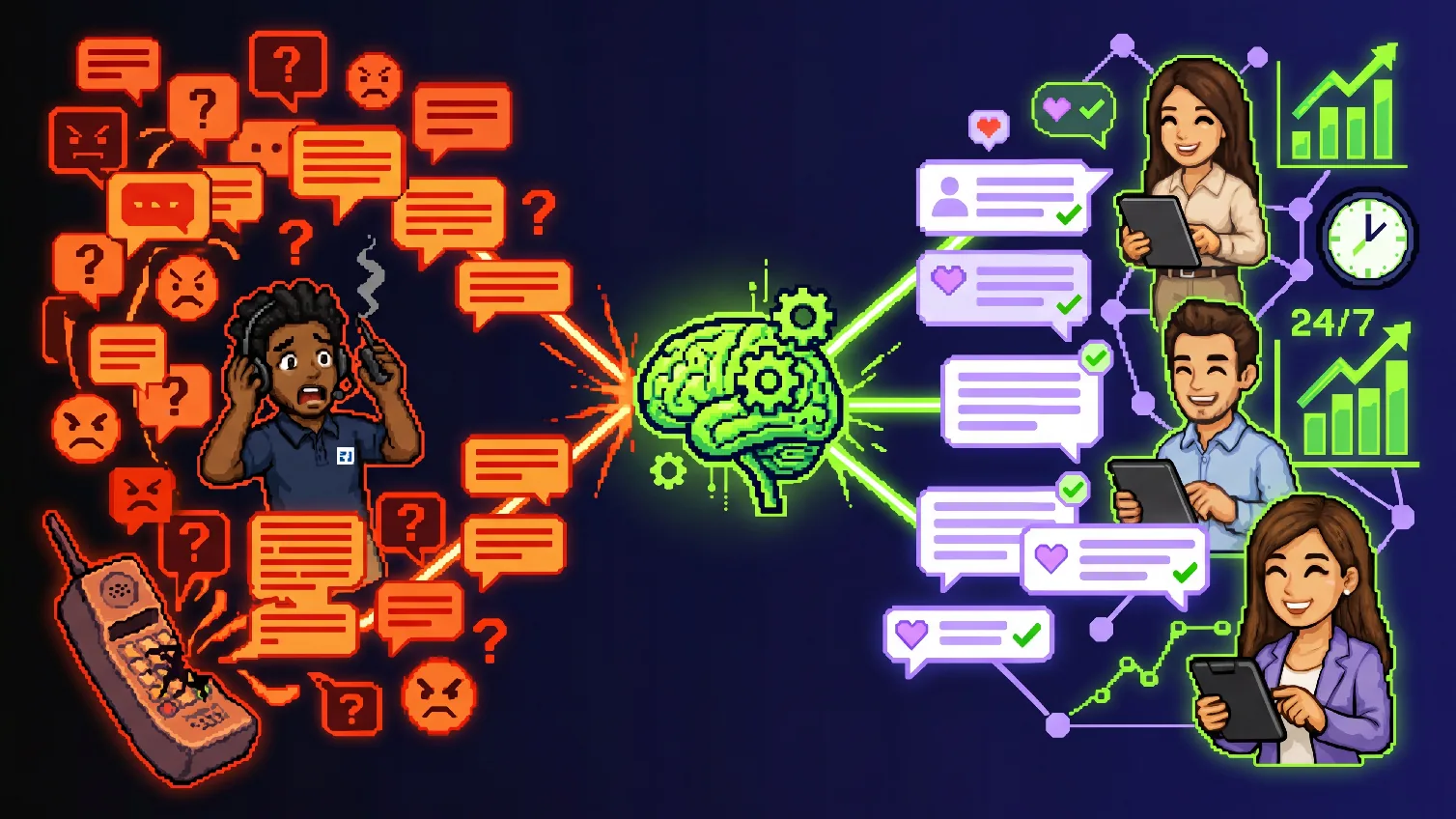
Every unanswered DM, SMS, email, or WhatsApp ping is a tiny hole in your revenue bucket. In 2026, customers expect “right-now” answers delivered in a tone that feels human whether it’s 2 p.m. or 2 a.m. An AI message responder plugs those leaks by stepping in the second a message lands and keeping the conversation moving until your team can jump in or often closing the loop all on its own. With 75 % of executives planning to automate at least half of customer inquiries within three years, lagging behind is no longer an option.
What Is an AI Message Responder?
An AI message responder is a conversational engine that reads inbound messages across various channels, interprets intent with natural-language processing, and delivers context-aware replies instantly and at scale. Unlike a canned autoresponder, it learns from your knowledge base, CRM, and past tickets, continuously improving its answers and escalating only the gnarly edge cases to humans.
How Does an AI Message Responder Work?
- Ingestion and Training – Connect data sources like knowledge base, past conversations, FAQs, and product catalog. The model fine-tunes on your brand voice.
- Intent Detection – NLP and LLMs classify the incoming query, pull entities such as order ID and appointment date, and map them to workflows.
- Response Generation – The engine drafts a reply, pushes it through guardrails including tone, length and compliance checks, and personalizes with customer data.
- Action Execution – For transactional queries it can trigger downstream actions, such as refunds, appointment slots, and status lookups among others via API.
- Continuous Learning – Each conversation is scored for success; low-confidence answers are routed to agents, then fed back to retrain the model.
Top Features of an AI Message Responder
Omnichannel Coverage
One brain for chat, email, SMS, WhatsApp, Facebook, Google Business Messages.
24/7 Self-Service
Zero-lag replies even during holidays or peak bursts.
Dynamic Personalization
Pulls real-time data like order status, account tier, and more to craft bespoke answers.
No-Code Workflow Builder
Drag-and-drop intents into flows so ops teams, not engineers, own the conversation design.
Sentiment and Priority Scoring
Flags angry VIPs or time-sensitive requests for human takeover.
Compliance Guardrails
Redacts PII, logs consent, and stores transcripts to satisfy GDPR/CCPA/HIPAA.
Analytics and A/B Testing
Track CSAT, deflection rate, revenue influenced, and split-test copy to keep leveling up.
Benefits for Businesses
Higher Conversion and Retention
When prospects DM at midnight about pricing or appointment slots, lightning-fast, personalized replies keep them on the hook instead of ghosting to a competitor. Our clients see up to 30% lift in first-contact conversion and a measurable bump in repeat purchases because customers feel taken care of every time they reach out.
Cost Compression
Tier-1 inquiries like “Where’s my order?” or “Do you service my ZIP code?” make up the bulk of chatter and cost. Automating 60-80% of those tickets slices labor spend while also shrinking average handle time for the complex 20 % that humans still tackle. One HVAC company cut annual support payroll by ~$57K yet handled 3× the volume after rolling out AI responders.
Agent Happiness and Productivity
Nobody was hired to copy-paste tracking numbers all day. Freeing agents from repetitive drudgery lets them upsell maintenance plans, chase high-value leads, or solve thorny technical issues – work that drives both revenue and job satisfaction. Teams using ServiceAgent typically report 15-20% lower attrition within six months.
Always-On Brand Voice
Every response across email, WhatsApp, Instagram, or SMS mirrors your chosen tone: friendly, authoritative, witty, you decide. No more “Good evening, Sir/Madam” on one channel and “Hey there” in another. Consistency builds trust, and trust is the lubricant for high-priced conversions.
Actionable Insights
AI tags every chat by intent, sentiment, and outcome, then surfaces dashboards that highlight friction points (e.g., refund requests spike after a specific promotion) or emerging product requests. Instead of sifting through transcripts, you get data-backed playbooks for product, sales, and marketing.
24/7 Revenue Capture
Your ads run round the clock and your replies should, too. An AI responder books appointments, issues quotes, and collects payments while your team sleeps, turning late-night browsers into booked-and-paid customers. Many ServiceAgent users credit after-hours automation for 10-15% incremental monthly revenue.
Scalability Without Chaos
Seasonal surge? Viral marketing moment? Just landed a feature on Morning Brew? The AI scales instantly – no frantic hiring, no wait times ballooning to five minutes. You maintain a premium customer experience even under 5× normal volume.
Regulatory and Security Peace of Mind
Built-in PII masking, audit trails, and consent logging keep you on the right side of GDPR, CCPA, HIPAA, and sector-specific rules. That minimizes compliance risk and frees your legal team from nightmare scenarios.
Competitive Differentiation
Most competitors still rely on autoresponders or limited live-chat hours. Offering natural, on-brand, 24/7 conversations becomes a marketable USP, one that shows up in five-star reviews and word-of-mouth referrals.
Quick math: Combine the extra revenue from captured leads, the savings on support payroll, and the upsell lift from happier agents, and an AI message responder often pays for itself within one quarter, then keeps compounding year after year.
Use Cases by Industry
Home Services
- Quote requests
- ETA updates
- After-hours emergencies
E-commerce
- Order tracking
- Returns
- Size guides
Healthcare
- Appointment reminders
- Symptom triage
- Insurance pre-check
SaaS and B2B
- Onboarding tips
- Plan upgrades
- Renewal nudges
Real Estate
- Lead qualification
- Property info
- Viewing schedules
AI Message Responder vs. “Traditional” Chatbots
| Capability | Legacy Rule-Based Bot | Modern AI Message Responder |
| Understanding | Keyword triggers | Semantic intent detection |
| Answers | Static scripts | Generative, dynamic replies |
| Channels | Usually website chat only | Email, SMS, social, chat, voice |
| Maintenance | Manual script edits | Self-learning with human review |
| Personalization | Limited tokens | Real-time CRM & order data |
| Escalation | Basic transfer | Sentiment-based, contextual hand-off |
Best AI Message Responder Tools in 2026
Spoiler: ServiceAgent tops the list, but here’s the landscape you’ll be comparing.
- ServiceAgent AI – A 24/7, trade-trained message responder for home- and field-service brands. It greets prospects in your own tone, captures job details, books the visit straight into your preferred CRM, and hands tricky cases to a live rep, all in under 300 ms. Flat-rate pricing and SOC 2 Type II security keep budgets predictable and data protected.
- Intercom Fin – Robust knowledge retrieval with “Tasks” that trigger backend actions, great for SaaS.
- Zendesk AI Agent – Natively embedded in Support Suite; new “instructions” feature lets you steer generative replies without code.
- Ada CX – Playbooks for complex multi-step resolutions, plus 100+ language support.
- Salesforce Einstein Service Replies – Tight CRM loop, draft suggestions inside the Service Console and Gmail.
- Tidio Lyro & Copilot – SMB-friendly pricing, quick setup for e-commerce live chat + email automation.
How to Set Up an AI Message Responder for Your Business
- Audit Your Conversations – Pull six months of tickets to spot top intents and volume by channel.
- Select Your Engine – Weigh must-have features (voice? WhatsApp?) against budget and IT resources.
- Connect Data – Sync knowledge base, CRM, order system, scheduling software.
- Design Workflows – Map FAQs for full automation; set fallback and escalation rules for gray areas.
- Define Brand Voice & Guardrails – Examples, tone sliders, forbidden phrases, regulatory constraints.
- Pilot & Measure – Roll out on one low-risk channel, track CSAT, deflection, and average handle time.
- Scale & Iterate – Add channels, feed transcripts back for continuous improvement, A/B test copy.
Privacy, Compliance, and Ethical Use
Data Minimization
Store only what fuels the workflow (name, address, service type). Skip marketing extras unless the caller explicitly opts in; less data = smaller breach risk and easier GDPR/CCPA audits.
Transparent Disclosure
Open every conversation with “You’re speaking with our AI assistant; I’ll transfer you to a human at any time.” Clear disclosures satisfy FTC guidance and defuse trust issues before they start.
Bias Monitoring
Sample 1–2% of transcripts each week and run them through fairness checks (pronoun use, tone, resolution time) to catch any skew that could disadvantage certain accents, genders, or ZIP codes.
Retention Policies
Define up front how long raw audio, text transcripts, and metadata live (e.g., 30 days for audio, 90 days for text) and where they’re stored (encrypted S3 bucket in the caller’s region). Publish these timelines in your privacy notice.
Regulatory Alignment
Map every feature against GDPR, CCPA, HIPAA, and PCI-DSS where relevant:
- GDPR/CCPA → right to access/erase, data locality
- HIPAA → encryption at rest/in transit, BAAs
- PCI-DSS → no card numbers in free-text fields, tokenized payments only
Fail-Safe Design
Set a confidence threshold (e.g., 0.85). Any intent score below that triggers an immediate human hand-off, never let AI bluff, guess, or hallucinate on compliance-sensitive topics.
These six guardrails keep your conversational AI both legally sound and ethically trustworthy without bogging the customer experience down in red tape.
Why Choose ServiceAgent for AI Messaging
ServiceAgent was built specifically for high-velocity service businesses (plumbers, HVAC pros, roofers, auto care, you name it) who can’t afford missed messages or lukewarm leads.
Here’s your unfair advantage:
- Voice-to-Text Fusion – The same AI that books calls can instantly pivot to text channels, keeping context intact.
- Job-Booking Automations – Real-time calendar sync, quote generation, and payment links baked in.
- Human-Sounding Voice Clones – Keep your brand’s personality front-and-center even at 3 a.m.
- Field-Ready Integrations – Works out of the box with 30+ CRMs.
- Actionable Dashboards – Track booked-jobs revenue, lead sources, and AI deflection in one place.
- White-Glove Onboarding – Our team configures workflows and trains your bot so you’re live, and capturing every dollar in days, not months.
Bottom line: while generic platforms chase vanity features, ServiceAgent zeroes in on the metrics that move your P&L, inclusive of booked jobs, higher ticket sizes, lower overhead.
The Upshot
Customers won’t wait and with AI message responders, they don’t have to. Whether you’re fielding midnight emergency requests or mid-morning “where’s-my-order” pings, the technology exists today to answer instantly, book the job, and leave competitors choking on digital dust.
Ready to turn every message into money? ServiceAgent is the smartest hire you’ll make this year.
Frequently Asked Questions
The questions home service operators ask most often.
1. Is an AI message responder the same as a chatbot?
Not quite. A chatbot often lives on one channel (usually your website) and follows scripted flows. An AI message responder is omnichannel, generative, and taps live business data to personalize every answer.
2.How long does deployment take?
With ServiceAgent, most teams are fully live in 7-10 business days including integrations and voice-training.
3.Will it replace my human agents?
No. It handles repetitive tier-1 tasks so your experts can focus on complex problems and revenue-generating conversations.
4.How do I measure ROI?
Track deflection rate, response-time reduction, booked-job conversions, and incremental revenue captured after hours.
What is an AI message responder?
An AI message responder is a conversational engine that reads inbound messages across various channels, interprets intent with natural-language processing, and delivers context-aware replies instantly and at scale. Unlike a canned autoresponder, it learns from your knowledge base, CRM, and past tickets, continuously improving its answers and escalating only the gnarly edge cases to humans.
How does an AI message responder work?
It works in stages: (1) ingestion and training from your knowledge base and past tickets; (2) intent detection via NLP/LLMs; (3) response generation with tone, length, and compliance guardrails; (4) action execution—like refunds, status lookups, appointment bookings via APIs; (5) continuous learning through scoring and human-in-the-loop retraining.
What are the top features of an AI message responder?
Key features include omnichannel coverage, 24/7 self-service, dynamic personalization using real-time customer data, a no-code workflow builder, sentiment and priority scoring, compliance guardrails (PII redaction, consent tracking), and analytics with A/B testing capabilities.
What benefits does it bring for businesses?
Businesses gain higher conversion and retention (up to 30% lift in first-contact conversion), cost reduction by automating 60-80% of tier-1 inquiries, improved agent happiness and productivity, consistent brand voice, actionable insights, 24/7 revenue capture, scalability without chaos, and peace of mind on regulatory and security fronts.
How does an AI message responder differ from traditional chatbots?
Unlike legacy chatbots that follow scripted, keyword-triggered flows on a single channel, AI message responders are omnichannel, generative, learn continually, personalize using CRM data, and escalate smartly based on sentiment and context.
How long does deployment take?
With ServiceAgent, typical deployment—including integrations and voice training—takes 7 to 10 business days.
Will it replace human agents?
No. It handles repetitive tier-1 tasks so human agents can focus on complex issues and revenue-generating conversations.
How do you measure ROI?
You measure ROI via metrics such as deflection rate, response-time reduction, booked-job conversions, and incremental after-hours revenue.
Who worked on this

Shaambhav Shankar
Growth & Product Marketing, ServiceAgent
Leads growth and product marketing for ServiceAgent at SaaS Labs, where he has worked in product marketing since 2020. Writes the blog's coverage of AI call answering, CRM and home-services operations.
Related reading

AI Phone Calls: The Complete Guide to Supercharging Your Call Operations with Voice AI
Learn how AI phone calls work, why businesses are switching to voice AI, and how to implement an AI calling system that improves customer experience around the clock.

Sierra AI Alternatives in 2026: 6 Options Scored on What Runs Your Front Office
The best Sierra AI alternatives in 2026, scored against Sierra's own gaps on the ServiceAgent Grid: who answers, who books, who runs the CRM, payments and dispatch, with verified pricing and real reviews.

Voiceflow Alternatives in 2026: 6 Options Scored on What Runs Your Front Office
The best Voiceflow alternatives in 2026, scored against Voiceflow's own limits on the ServiceAgent Grid: who answers, who books, who runs the CRM, payments and dispatch, with verified pricing and real reviews.